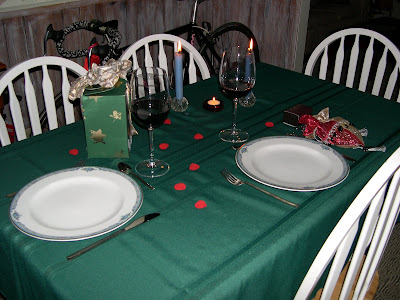
I absolutely adore to eat dinner the French way. The Anglophile way of eating is to bring everything to the table at once. I ate this way my whole life until I visited France. The first time I ate dinner with a French family, approximately six hours after arriving in France for an eight month stay, and a plate of cold cuts was brought to the table, I thought for sure I would die of starvation. I did not realize that meals are brought to the table in courses. In short, I thought cold cuts
was dinner.
Another reason I thought that was the whole dinner, is that the French actually take the time to sit together and talk. There is usually what seems to be an inordinate amount of time for the Anglophile between each course. Although dinner is by no means timed, I provided educated guesses at the length of time that might be spent per course to give you an idea. A typical French dinner consists of an apéritif, followed by hors d’œvre, a plat principal, salade, fromage, dessert, café. When guests are invited, they do not generally know what will be served, and do not find out until that course is brought to the table. That is part of the magic. The full French dinner goes something like this :
1. Apéritif
2. Hors d’œvre/ Entrée
3. 1er Plat Principal
4. Trou Normand
5. 2ème Plat Principal
6. Salade
7. Fromage
8. Dessert
9. Café
10. Digestif
Let me break it down for you :
1. ApéritifThis could be a lot of different things. In an informal setting, the apéritif often takes place in a living room around the coffee table. Often times a selection of liquor is offered including
Martini & Rossi, whisky, cognac, etc. A modern take on the apéritif is to drink champagne.
Amuses-bouche usually go along with the apéritif. In an informal setting, this may be nuts, processed cheese such as
La Vache qui rit, or
sausisse seche. Formally,
canapés, or other fancier appetizers may be served.
Time : Up to an hour to sit, talk, snack, and drink. Then the party normally moves to the table.
 Friends share champagne, and American dishes learned during their time as exchange students.
2. Hors d’œvre/ Entrée
This can be anything from soup, to a slice of smoked salmon with capers, dill, and crème fraîche, crudités, or the plate of cold cuts I mentioned above. It is usually a small portion. If champagne was served for the apéritif, it is often carried into the hors d’œvre/ entrée. Another option is to serve a wine which will carry over into the 1er Plat Principal.
Time : About 15 minutes to eat, and 15-30 minutes down time while the chef prepares the next, and first large course.
3. 1er Plat Principal
This is the first large course. I don’t think there is a hard and fast rule about what must be served, but it seems like it was usually seafood. For example, Stingray with capers (to die for), sauce, potatoes with butter and parsley. Of course, baguettes are served sliced on a bias, and it does not seem to be rude to sop up the sauce with the baguette. Of course, if seafood is served, a white wine such as Sancerre would be served.
Time : About 20 minutes to eat, and 20 minutes to sit and talk.
 Paella4. Trou Normand
The
Trou Normand is a shot of eau de vie that is taken between two large courses. I am told that it helps when one is stuffed to the gills by helping digest what is in your stomach to make room for the next course. Traditionally
Calvados is drank, but I have seen other eau de vies. The
modern twist on the Trou Normand is to pour a shot of Calva on apple sorbet. When I ate with young Parisians, the sorbet Calva combination was almost always served. When I ate with people of the older generation, or people in small villages, it was often times a shot.
Time : About 15 minutes. At this time, some dinner parties I went to even pushed the furniture aside and danced for about an hour before moving onto the 2ème Plat Principal.
5. 2ème Plat PrincipalThis is the last large course of the dinner. Again, . I don’t think there is a hard and fast rule about what must be served, but in my experience, it was usually a red meat dish, such as
Tournedos Rossini, again in sauce, with some type of vegetable dish on the side. I also saw pork, lamb, or even a second seafood dish such as
langoustines served. Unless seafood was again served, a red wine such as a
St. Emilion would be served.
Time : About 20 minutes to eat, and 20 minutes to sit and talk.
 Poule au Pot
6. Salade
I thought this was very strange the first time I experienced it. I was so used to eating salad at the beginning of the meal, and thought it strange to eat it at the end of the meal. I am told that the French believe eating salad after the meal helps with the digestion, whereas if it is consumed before the other food, it cannot "help the food pass." After many many meals in France, I believe salad should be at the end of the meal.
Time: 15 minutes.
 Fresh is best
7. Fromage
At this point, a plate of different cheeses are brought out. One can take as many different cheeses as one wants, and as much as one wants, but it is considered rude to leave it on your plate. For this reason, my practice was to take only a sliver of unfamiliar cheese, then ask for seconds if it pleased me. The rule when eating cheese is start with the least strong and make your way up to the strongest. Of course, the French eat their cheese with red wine, and baguette slices, never crackers.
Some of the cheese will linger on the palate for a long time after consumption. A sip of red wine will recall the stronger cheeses over and over. It is for this reason that the French say, "a real eater of cheese stays with his cheese." Translation : "No dessert for me please.
Time:15 min. There is often a pause between fromage and dessert.
 Farm Cheese
8. Dessert
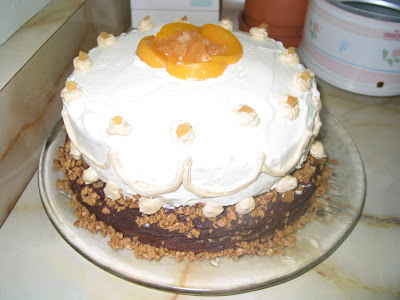
However, I have heard that saying every time I ate dinner, but rarely saw anyone refuse dessert. A dessert at a daily dinner would consist of whatever fruit is in season, and yogurt. At a full meal, it could be a
tart tatin, a
crème brulée,
pears poached in red wine, well, you know all the classic French desserts.
Time: 20 minutes.
9. Café
This is served in a very small cup, but is still very strong coffee. Coffee is not usually served with the dessert.
Time: 15 minutes.
10. Digestif
The final drink of the night. Usually something strong like cognac, whiskey, brandy, mirabelle eau de vie, etc. Myself I prefer
Grand Marnier.
Time: Up to several hours.
 Mission Bay on the Pacific is saturated with joggers, rollerbladers, cyclists, and surfers. While there, I decided to check out a local tradition, the Lahaina Beach House, where I sampled Fish Tacos and Blue Moon wheat beer.
 The Lahaina Beach House is a very small and simple bungalow bar, with a view of the Pacific from its outdoor deck. Loud rock music, sunshine, palm trees, waves and beer accentuate the surrounding hard bodies and bikinis and makes the deck at Lahaina Beach House a great place to people watch.
 Later that night, I was introduced to a couple of San Diego beers, Stone Pale Ale, and Karl Strauss Red Trolley Ale. Both beers were good, Stone being a strong example of a Pale Ale. Red Trolley kept me coming back for pint after pint, though. The beer was malty, carameley, and smooth. It was excellent to drink while walking along Mission Bay.


